
Fun Elementary Math Picture Books
I earn a commission from products purchased through links in this post.
Did you know there is a National Math Storytelling Day? What an awesome holiday! National Math Storytelling Day falls on September 25th. It is like a holiday made for homeschoolers. This is a perfect opportunity to incorporate math picture books into lesson plans.
I love math storybooks. They teach math in a way that even math-phobic kids can enjoy and relate to, without the stress they might feel from a sheet of math problems.
Truly understanding math concepts is so much more important than just memorizing facts. Understanding comes from being able to build experiences with your hands. Understanding also comes with thinking about concepts differently and relating them to real life.
In honor of Math Storytelling Day, I put together 6 math centers that are built around math picture books. Read the stories and then set up the centers. You can set up one a day for a week or make an entire day of it and do all of the activities in one day.
Fun Elementary Math Picture Books

Alexander, Who Used to Be Rich Last Sunday
Alexander, Who Used to Be Rich Last Sunday, by Judith Viorst, is about a young boy who squanders away the money he is given by his grandparents.


Last update on 2026-09-16 / Affiliate links / Images from Amazon Product Advertising API
Skills: Money, addition, and budgeting
Materials:
- grocery store sales flyer
- pretend money
- paper and pencil
- toy cash register (optional)
Activities
Ask your children to plan a meal using the sales flyer. Give them a budget to work within. You can do this activity multiple times by assigning different budgets.
I asked my kids to plan a breakfast for $10, lunch for $15, and dinner for $20. Give the children play money and let them fulfill their dietary dreams by creating their meal plans.
Once the meal plan is complete they can add up their bill and make change. Multiple children can work together by filling the roles of shopper and cashier.
Sir Cumference and All the Kings Tens
Sir Cumference and All the Kings Tens, by Cindy Neuschwander is part of the Sir Cumference series of math picture books. Lady Di is trying to count guests for a birthday party but there are too many to count individually. The kingdom works together to figure out a way to count large numbers quickly.

Last update on 2026-09-16 / Affiliate links / Images from Amazon Product Advertising API
Skills: Place value
Materials:
- base ten blocks
- index cards and marker
Activities
Write three and four-digit numbers on index cards. Place the index cards by the base ten blocks and ask your children to model the number using the base ten blocks. Be sure to set up the blocks with the thousands on the left and the ones on the right. This reinforces the order in which we write numbers.
The Great Divide
The Great Divide, by Suzanne Slade, is a rhyming book that shows division using real-life animal examples. This is a great math picture book for animal lovers. The last few pages of the book contain information on multiplication and division principles.

Last update on 2026-09-16 / Affiliate links / Images from Amazon Product Advertising API
The publisher, Sylvan Dell Publishing, has assembled a cross-curricular teaching guide so you can create an entire unit study using this picture book!
Skills: Division
Materials:
- math manipulatives (dried beans, mini erasers, unifix cubes, Hershey kisses, etc.)
Activities
Ask your child to solve the math problems with the manipulatives while you are reading the story. The rhyming text of this story makes it a natural fit for Tea with Poetry.
Spaghetti and Meatballs For All
Spaghetti and Meatballs for All, by Marilyn Burns, tells the story of the Comfort family reunion. Guests keep showing up so the seating arrangement is constantly changing to make room for everyone.

Last update on 2026-09-16 / Affiliate links / Images from Amazon Product Advertising API
Skills: Area and perimeter
Materials:
- sticky notes
Activities
Use the sticky notes to act out the story, pretending that the notes are tables. Ask your children to figure out different ways to seat various numbers of guests – 12, 16, 24, 36, 52, etc. Make it fun by letting them invite all of the characters from their favorite tv show.
If You Were A Quadrilateral
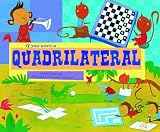
If You Were A Quadrilateral, by Molly Blaisdell, is a great book for introducing big geometry words such as parallelogram and rhombus.
Last update on 2026-09-16 / Affiliate links / Images from Amazon Product Advertising API
Skills: Geometry vocabulary
Materials:
Activities
Sort the shapes into two piles – quadrilateral and not quadrilateral. You can take it a step further and separate the quadrilateral pile into rectangles, squares, and rhombuses.
Don’t Wake Daddy Late-Night Snack
Don’t Wake Daddy Late-Night Snack, by Jackie Glassman, is a very easy reader book that tells the story of children sneaking out of bed for a late-night snack. Analog and digital clocks appear throughout the illustrations.

Last update on 2026-09-16 / Affiliate links / Images from Amazon Product Advertising API
Skills: Telling time and measuring time
Materials:
- clock matching puzzles
- two pretend wooden clocks
- timer
Activities
There are a few activities that naturally go along with this book.
- Match up clock puzzles so that the digital clock and analog clock both show the same time.
- Calculate the time elapsed between two pretend clocks.
- See how much you can do in 60 seconds. How far can you run? How many jumping jacks can you do?

We are even bringing math into a special Tea with Poetry on Monday!
We will read math-themed poetry on Math Storytelling Day. Did you even know there was such a thing as math poetry? I will put small sweet treats, such as Hershey’s Kisses, on our treat tray so we can model some of the math stories.
We will be reading:
- The Best of Times by Greg Tang
- Math Potatoes by Greg Tang
- Math-terpieces: The Art of Problem-Solving by Greg Tang
I recently attended a math workshop that focused on using current brain research in math instruction. One of the things that was taught was that stories and puzzles are a great way to warm up for math lessons. Remember those timed math drills we had in school? Those are out, and math puzzles are in! They are better for fostering a growth mindset.
I found an awesome book of math puzzles at the library to use over the next week or two. We will read and solve a puzzle from Whodunit Math Puzzles, by Bill Wise.
Keep reading . . .
- Celebrate Pi Day
- Books About the Fibonacci Sequence for Kids
- Math Board Games Kids Will Enjoy
- September Homeschool Activities
- Valentine’s Day Math Activities
- A Math Mammoth Review
- Math with Confidence Kindergarten: Honest Review
As an Amazon Associate I earn from qualifying purchases.